China to 3PL Shipping Preparation: What the Receiving Warehouse Needs
By Vincent Yu · Published 2026-10-08
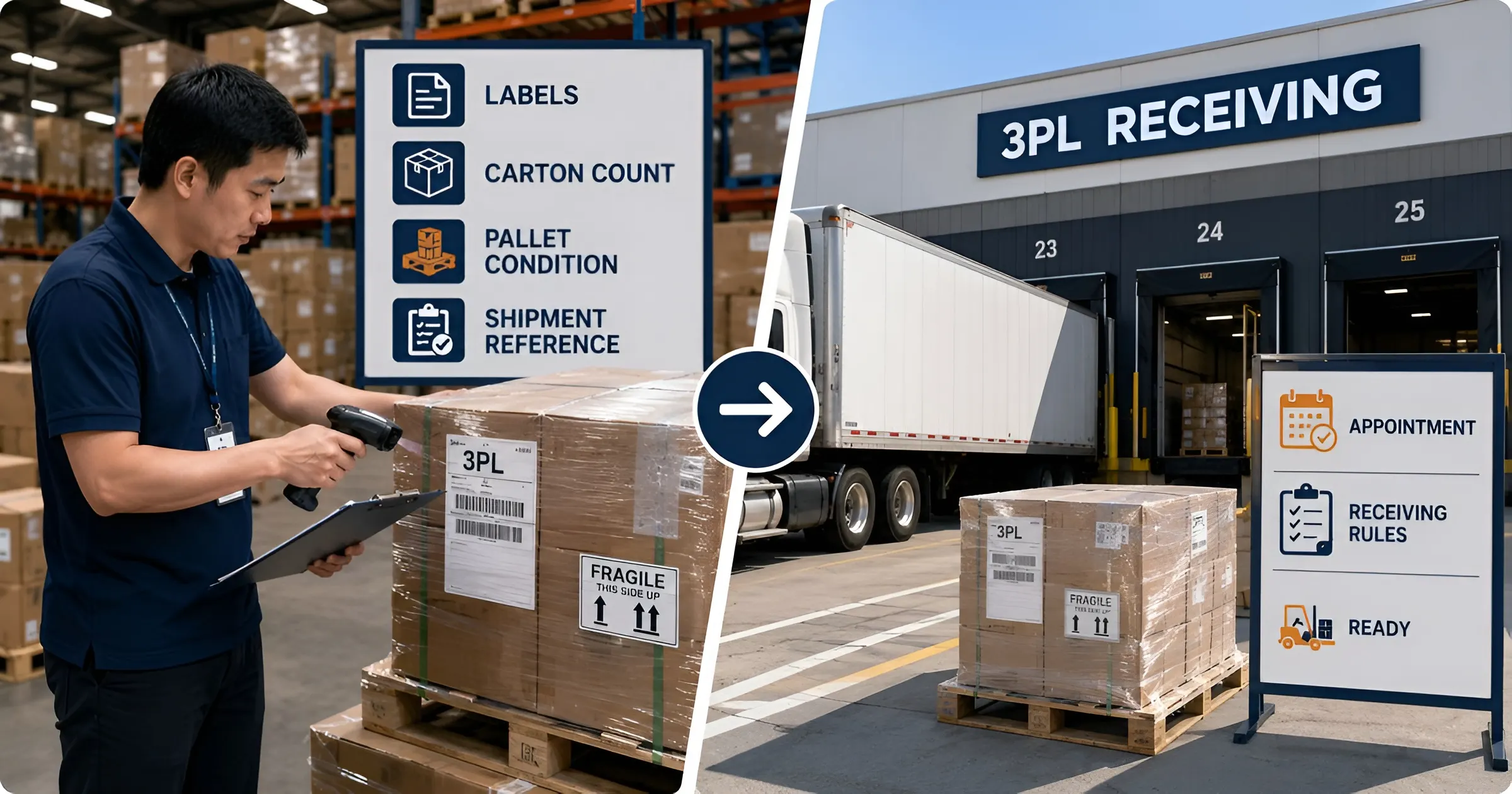
What does the receiving warehouse need before the container leaves China?
Receiving normally means unloading, counting and reconciling inventory, and sometimes assembling items into final packages. Each of those steps depends on data that exists before the goods ship, so information that only surfaces at the dock turns a routine receipt into an exception queue.
A practical pre-release package, offered here as a planning recommendation rather than a universal requirement, covers the items in the list below. Confirm the exact fields, forms and portals with your actual receiving provider, because the supplied sources do not describe how every 3PL structures its inbound instructions.
- Advance shipment notice, sent before the container departs rather than on arrival.
- Commercial invoice and packing list that match SKU by SKU.
- Carton count, pallet count and units per carton.
- SKU-level quantity list with barcodes.
- Label specification and any custom-work instruction.
- Dock appointment constraints agreed with the receiving site.
Provider-specific example: ShipBob's receiving guide uses a Warehouse Receiving Order for inbound inventory, and identifies the fulfillment center, inventory items, box details and labels. These are ShipBob-specific examples, so map your package to the instructions of the provider that will actually receive your goods.
Decision rule (planning recommendation): if any package field is blank when the factory releases the goods, treat the shipment as not ready to book a dock appointment.
| Field | Owner | Status | Verification evidence |
|---|---|---|---|
| Commercial invoice | Factory / brand | Received, verified or missing | Document name and version |
| Packing list by SKU | Factory | Received, verified or missing | Matches invoice line by line |
| Carton and pallet count | Factory / forwarder | Received, verified or missing | Loading photos or tally sheet |
| Label specification | Brand / 3PL | Received, verified or missing | Approved label sample reference |
| Dock appointment constraints | 3PL | Received, verified or missing | Written confirmation from receiving site |
Open question to settle per project: exactly what the forwarder must supply so the warehouse can book a dock appointment accurately. Record the answer in the shipment instruction sheet, with a named owner.
Is an inbound task standard receiving or custom work?
Classify each inbound task before freight is booked. Some providers separate standard fulfillment from custom packing and kitting arrangements that need setup first. ShipBob's rules are one example of that split, not a universal warehouse policy, so another agreement may treat the same task differently.
Use precise vocabulary when you request work. In MoldShifu's planning terms, assembly means joining parts into a finished item, while kitting means grouping finished items into a set. Treat them as different service requests and agree which one you mean in writing, because a mixed-up term leads to the wrong work order.
| Inbound task | Standard or custom? | Setup before booking freight? | Written instruction? |
|---|---|---|---|
| Count and put away | Usually standard; confirm with 3PL | Confirm with 3PL | Receiving sheet |
| Apply a sticker | Confirm per provider | Confirm per provider | Label spec and placement reference |
| Join two components (assembly) | Treat as custom | Agree before booking | Work instruction and reference unit |
| Group finished items into a set (kitting) | Treat as custom | Agree before booking | Bill of materials per kit |
| Repack into a new carton | Confirm the line with 3PL | Confirm per provider | Packing spec |
Open question: where a given 3PL draws the line between kitting and simple repacking, and whether stickers or non-standard packaging count as custom work. The supplied provider rules do not settle this for every warehouse, so confirm each SKU's classification in writing before arrival rather than at the dock.
Written work instruction per SKU.
Bill of materials for each kit or assembly.
Approved reference unit.
Packing and label specification.
Rework and scrap policy.
Agreed turnaround expectations.

Who owns customs data, and should the container ship DDP or DDU?
Decide DDP or DDU per lane, and confirm that HS codes, declared value and country of origin are verified before departure. Incorrect or incomplete paperwork is a common cause of customs delay. This article gives no classification advice, so have a forwarder or licensed customs broker confirm the codes.
DDP means duties are paid upfront by the seller or fulfillment partner. DDU means the recipient pays duties and taxes on arrival. The source describes these terms in a creator-fulfillment context, so applying them to a bulk container consigned to a 3PL is by analogy: document who pays charges so the warehouse knows whether to expect them.
One creator-oriented guide for US inbound freight says clearance is usually one to two weeks with clean paperwork, and that CBP examines roughly 3-5% of containers. It adds that first-time importers and shipments with documentation, valuation or HS code issues are commonly selected for inspection. That is guidance, not a customs ruling.
MoldShifu does not guarantee DDP. Duty terms are agreed per project. How to document DDP or DDU for a 3PL consignee, rather than a retail recipient, is an open question to settle with your forwarder or customs broker.
- HS code per SKU, with the name of who confirmed it.
- Declared value per unit and the basis for it.
- Country of origin per SKU.
- Packing list matching the invoice SKU by SKU.
- DDP or DDU choice per lane, in writing.
- Named forwarder or customs broker.
- Who pays duty, tax and any examination fees.
Planning recommendation: a first-time importer should add inspection time to the schedule, since that profile is commonly selected for inspection.
How do you verify labels, barcodes and carton data before release?
Set label, barcode and carton-content requirements with the factory in writing, then verify them with evidence before shipment release. Receiving relies on counting and reconciliation, so a carton whose label or quantity cannot be matched to the packing list is a variance someone has to resolve.
Ownership is an open question. When goods are made in China and received by a third-party warehouse in the destination market, name an owner (brand, factory or 3PL) for each label type in the agreement. Do not assume it is understood.
- Photo of each carton label, showing SKU and quantity.
- Scan test of a sample barcode from each SKU.
- Carton quantity matching the packing list.
- A stated rule on mixed-SKU cartons: accepted or not, and how they are labeled.
Illustrative arithmetic (assumed inputs): a packing list shows 10 cartons of 48 pieces for one SKU, so the expected total is 10 × 48 = 480 pieces. A carton marked 40 pieces, or a ninth carton with mixed content, is a variance. Raise it before shipping, not after unloading.
| SKU | Units per carton | Cartons | Expected total | Barcode scanned | Label photo ref | Variance note |
|---|---|---|---|---|---|---|
| Example SKU A | 48 pcs | 10 | 480 pcs | Y or N | Photo ID | Blank if none |
| Example SKU B | 24 pcs | 6 | 144 pcs | Y or N | Photo ID | Blank if none |

How much schedule buffer belongs between production finish and sellable stock?
Do not plan to the shortest quoted transit. One guide cites Flexport Ocean Timeliness Indicator averages of about 37 days from China to the US West Coast, 53 days to the US East Coast and 58 days to North Europe for full bulk container shipments to a warehouse. They are averages, not guarantees.
Give customs clearance, possible inspection and warehouse receiving their own lines. Illustrative arithmetic with assumed inputs only: 37 days ocean average + 14 days clearance (the upper end of one to two weeks) + N days receiving agreed with the 3PL = 51 + N days from departure to sellable stock. Replace every figure with actual quotes.
Hypothetical scenario A: a brand ships a first ocean container to its US 3PL with no kitting. Treat it as standard receiving. Send the notice, packing list, carton count, SKU list and label spec, and confirm in writing that no custom work is needed. Because it is a first import, add inspection time.
Hypothetical scenario B: a 3PL receives goods needing light joining of parts, or grouping of finished items into sets. Decide whether it is assembly or kitting, treat it as custom, and agree instructions, bill of materials, reference unit, rework policy and turnaround before booking. Skipping this risks goods idling on the dock while scope is argued.
Hypothetical scenario C: a brand with global buyers sends some orders direct from Asia and the rest in bulk to a domestic 3PL. Separate the lanes, set DDP or DDU per lane, and name which partner owns receiving, assembly and kitting. Kickstarter's guide frames direct, domestic 3PL and hybrid routes as distinct planning choices.
| Scenario | Task class | Key documents | Duty term decision | Receiving owner | Main risk to check |
|---|---|---|---|---|---|
| A: first bulk container, no kitting | Standard receiving | Notice, invoice, packing list, label spec | DDP or DDU for the lane | 3PL | First-time importer inspection |
| B: joining or set-building on arrival | Custom: assembly or kitting | Work instruction, bill of materials, reference unit | Per lane | 3PL, by agreement | Scope disputes at the dock |
| C: direct plus bulk lanes | Mixed | Per-lane SKU and barcode lists | Separate per lane | Named per lane | Duty terms mixed across lanes |
MoldShifu's merch track can coordinate sourcing, samples, kitting and shipping, assessed project by project. Tooling and merch are separate service tracks, and routes, quantities and terms are agreed for the actual project.
Common questions
What information does a US 3PL need before a container from China arrives?
A sensible package includes an advance shipment notice, commercial invoice, packing list, carton and pallet counts, a SKU-level quantity list, label specification and dock appointment constraints. Exact fields vary by provider; ShipBob, for example, uses a Warehouse Receiving Order that identifies the fulfillment center, items, box details and labels. Confirm your receiving provider's instructions.
What is the difference between kitting and assembly for inbound goods?
In MoldShifu's planning terms, assembly joins parts into a finished item and kitting groups finished items into a set. Request and instruct them separately, because setup and rework rules may differ. Where kitting ends and simple repacking begins varies by provider, so confirm it per SKU.
Should a bulk container to a 3PL ship DDP or DDU?
It depends on who should carry duties and taxes. Under DDP the seller or fulfillment partner pays upfront; under DDU the recipient pays on arrival. Document the choice per lane so the warehouse knows whether to expect charges. MoldShifu does not guarantee DDP.
How much time should I add for customs and warehouse receiving after ocean transit?
One guide cites averages of about 37 days to the US West Coast and 53 to the East Coast, plus clearance of one to two weeks with clean paperwork. Add an inspection buffer, especially for first-time importers, and a receiving period agreed with the 3PL. These are planning figures, not guarantees.
Who is responsible for barcode and label compliance on goods made in China?
The supplied sources give no universal answer. Name an owner (brand, factory or 3PL) for each label type in the agreement, and require label photos, a barcode scan test and carton counts before release.