China Freight Forwarder Hidden Fees: A Quote Checklist for Small Businesses
By Vincent Yu · Published 2026-10-30

Seven quote traps that make freight totals incomparable
A low per-kilogram rate is only one part of a shipment quote. For a small brand ordering from several China suppliers, the decision is whether each provider has priced the same job. Use these seven questions before paying or sending goods to a warehouse.
| Trap | Question to ask in writing | Evidence to keep |
|---|---|---|
| Unmatched service scope | Which legs are included: supplier pickup, origin handling, main freight, destination delivery? | Quote response that lists each leg |
| Actual vs chargeable weight | Which weight basis is priced, and what are the divisor, minimum and rounding rules? | Written statement of the rule, plus your measured carton record |
| Unclear repacking or measurement changes | Who approves optional repacking, and what evidence supports a revised billable size? | Incoming and final measurements, photos and written approval for optional work |
| Omitted origin and destination charges | Which origin, destination, customs and tax lines are included, excluded or conditional? | Line-item list; any blank marked unconfirmed, not free |
| Vague DDP or door-to-door label | Which delivery point, customs responsibilities and importer arrangement are actually agreed? | Written service scope consistent with your buyer/seller terms |
| Price validity and change rules | What is the expiry date and what written events can change the price? | Dated rate sheet or email stating the expiry and change triggers |
| Handoff and claims ownership | Who receives, who signs at handoff, who handles damage or customs claims? | A named receiver and claims contact in the quote response |
Clearance-related costs can include documentation, inspection, duties, taxes and administration, varying with the goods, destination and agreed terms. The practical use of that fact is a question, not a formula: which of these are included, excluded or conditional in this quote?
A revised price alone does not prove misconduct. A changed final carton or an expired rate can legitimately change a quote, so check the measurement record, the agreed rule and the validity date before drawing conclusions.
Check the packed carton and the meaning of DDP
Ask for each finished carton's outer dimensions and gross weight, including its packaging. Product-only measurements are not the same record. Identify who supplied the figures and whether the quote is provisional until warehouse or carrier measurement.
DHL Express UK publishes a dimensional-weight calculation using centimetres divided by 5,000, compared with actual weight for each package. This is a provider-specific express example. Other services can have different billing bases, minimums and rounding; do not apply this divisor to every air or sea quote.
Illustration only: no live rate or customer shipment is represented.
| Record | Hypothetical carton | What it establishes |
|---|---|---|
| Final outer dimensions | 60 × 40 × 50 cm | The packed size used for this example |
| Actual gross weight | 15 kg | The assumed scale reading |
| Dimensional calculation | 60 × 40 × 50 ÷ 5,000 = 24 kg | DHL Express UK example, before service-specific rounding |
| Comparison | 24 kg is greater than 15 kg | The dimensional figure governs under the stated rule |
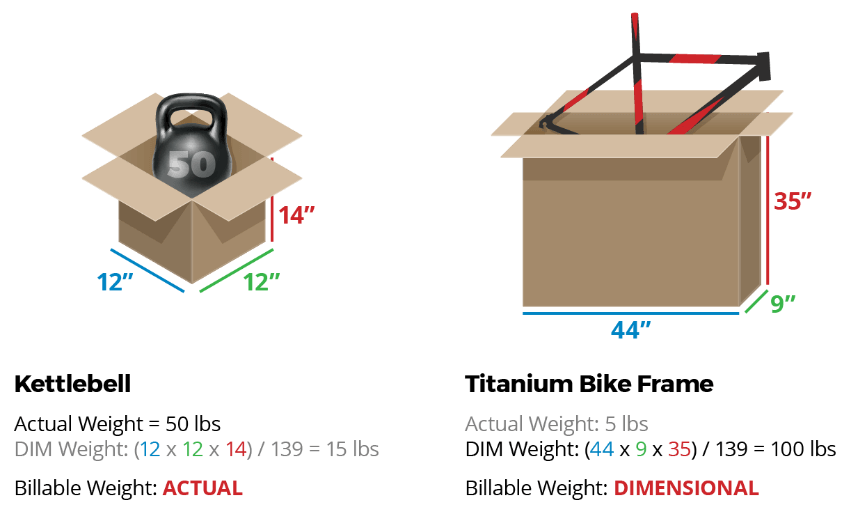
Concept illustration: this graphic uses inches, pounds and an example divisor of 139. The DHL Express UK example above uses centimetres, kilograms and 5,000. Use only the units, divisor and rounding confirmed for your chosen service.
If repacking changes the outside dimensions, the calculated volume also changes. Ask for the before-and-after record and a revised quote. Agree approval for optional repacking in advance, while allowing the provider to explain any mandatory carrier or safety requirement. More compact packing is useful only if the goods remain adequately protected.
DDP means Delivered Duty Paid; DAP means Delivered at Place. Under Incoterms 2020, these allocate duties and import-clearance responsibility between the buyer and seller: DDP assigns them to the seller, while DAP assigns them to the buyer. They do not determine tariff rates or customs procedures.
Keep that sales agreement separate from the forwarder's service quotation. A label such as DDP or door-to-door does not identify every party or prove that the shipment is correctly documented. Ask who arranges import entry, who is importer of record, what destination is covered and what evidence of clearance will be available.
Compare China freight quotes on the same basis
Send the same packing list and pickup-to-delivery requirements to each provider. Then compare their written answers using the fields below. This checklist is a buyer planning aid, not a carrier tariff or a published rate list.
| Comparison field | Ask every provider for | Before you rank the price |
|---|---|---|
| Same shipment | Pickup points, destination postcode, cargo description and packed carton data | Resolve any different shipment assumption |
| Service and billing | Transport mode, service scope, chargeable weight or volume, minimums and rounding | Keep different modes or scopes in separate comparisons |
| China-side work | Receiving, pickup, counting, consolidation, optional repacking and materials | Distinguish routine counts from a product-quality inspection |
| Destination and customs | Destination handling, brokerage, tax/duty responsibility and final delivery | Mark unconfirmed costs as open questions |
| Exceptions | Remote-area delivery, storage, inspection, redelivery or other conditional charges | Record when each applies and who pays |
| Validity and handoff | Currency, expiry, change triggers, receiving contact and claims procedure | Obtain missing answers before booking |
A blank charge is not the same as a zero charge. Keep confirmed charges, conditional costs and unresolved exclusions in separate columns in your working file. If currencies differ, record the exchange rate and date you use for comparison. Do not let a tidy subtotal imply that all costs are known.
For example, an apparently lower quote may stop at the destination terminal while another includes the onward delivery. Neither number alone tells you which offer is better. Ask both providers to quote the same end point and customs scope, then compare the revised totals and the remaining uncertainty.
Some extra charges are legitimate when the agreed conditions change. Ask for the triggering event, supporting record and revised cost before authorizing optional work or accepting a new quote. An explanation is stronger evidence than a headline promise of no hidden fees.
Send a clear RFQ and keep the evidence
A request for quotation, or RFQ, helps each provider answer the same shipment brief. Use the list below as a copyable starting point. If a detail is not final, label it estimated and ask what must be confirmed before booking.
- Cargo and suppliers: describe the goods, supplier locations, quantities and ready dates; disclose batteries, liquids or other special characteristics for service assessment.
- Packed shipment: provide carton count, outer length × width × height and gross weight for each carton; identify estimated versus measured figures.
- Delivery scope: state the pickup point and delivery postcode, business or residential address, and any warehouse appointment or unloading requirement.
- Costs: request receiving, consolidation, packing, origin, main freight, destination and final-delivery lines, plus included, excluded and conditional charges.
- Customs: ask who handles filings, importer-of-record arrangements, duties and taxes; request explanations consistent with the actual buyer/seller agreement.
- Approval and billing: request the weight/volume rule, minimum and rounding, approval for optional repacking, and evidence supporting later changes.
- Validity and timing: request a currency, expiry date, change triggers and an estimate that names its start and end events.
- Handoff and claims: request a responsible contact, shipment references, delivery evidence and the applicable loss/damage reporting process.

Keep the supplier packing list, incoming and final carton photos, measurement records, dated quote and written changes together. The commercial invoice and packing records must be prepared for the actual shipment; ask the responsible customs professional which documents are required. Do not rely on a delivery estimate to replace that preparation.
Warehouse receiving and parcel counts do not establish product quality. If you also need inspection, sample comparison or SKU-level verification, describe that work and its acceptance evidence separately in the scope.
Three buying situations and the next question to ask
These hypothetical situations illustrate purchasing decisions. They are not customer stories, market-rate examples or rules that automatically determine whether a charge is valid.
| Hypothetical situation | Evidence to request | Decision to resolve |
|---|---|---|
| A small apparel brand receives three different headline rates | The same destination, packed measurements, included legs and customs scope in every response | Which comparable total is confirmed, and what remains excluded? |
| A retailer's cartons change after optional repacking | The approval, before/after photos, final measurements and applicable billing rule | Does the revised quote follow the agreed change process? |
| Several suppliers send stock to one China receiving point | A supplier-to-carton record, counting scope, packing instructions and outbound handoff owner | Who authorizes release when an item is missing or the packing plan changes? |
A measurement record can explain a difference; it does not automatically approve every revised fee. Likewise, an expired quote may need repricing, but the replacement offer still needs a clear scope. Resolve the specific gap rather than assuming that every increase is misconduct or that every quoted total is complete.
For multiple suppliers, agree how missing or late cartons affect the outbound plan before the first delivery arrives. Holding everything, splitting the shipment or changing the kit contents can lead to different work and costs. Ask for those options in writing rather than assuming consolidation always saves money.
Prepare a China-side receiving and shipping brief
If you already have China suppliers but need coordination between purchasing and dispatch, MoldShifu can discuss receiving, supplier follow-up, consolidation, packing or kitting, and shipping handoffs within an agreed project scope. Tell us which tasks you need help with and which provider you already use.
- Send supplier locations, goods-ready dates, product descriptions and available packing records.
- Explain how items should be grouped, labelled and handed over, including any receiving-warehouse requirements.
- Provide the destination country and postcode, the requested delivery scope and the written quotes you want to compare.
We will assess the required work and route availability for that shipment. Brazil is not currently supported. Share approximate information for an initial scope discussion, then confirm the final packed data and terms before dispatch.
For the supplier handoff, see coordinating multiple China suppliers. If the shipment is going to a warehouse, use the China-to-3PL receiving preparation guide.
Common questions
Why did the freight quote increase after my goods reached the warehouse?
Final packed dimensions, gross weight, the service selected or quote validity may have changed. Request the before-and-after record and the agreed billing rule. A revised quote should explain the cause; a price increase alone does not prove misconduct.
Is chargeable weight the same as the weight on the scale?
Not necessarily. Under DHL Express UK's published example, the greater of actual and dimensional weight is used for each package. Confirm your service's own divisor, minimum and rounding. Do not apply an express formula to every air or sea shipment.
Can I treat a forwarder's DDP label as proof that all import work is covered?
No. Incoterms 2020 DDP sales terms allocate import clearance and duties to the seller, while DAP allocates them to the buyer. Still confirm the forwarder's actual service scope, importer arrangement, destination, documents and exclusions. The label is not proof of completed clearance.
Will consolidation always make a small shipment cheaper?
No saving should be assumed. Compare receiving, packing, materials, handling, final packed size and delivery scope for combined and separate shipments. Also check whether waiting for one supplier delays the rest. Use confirmed shipment-specific costs, not a generic per-kilogram claim.
What should I send before asking MoldShifu to compare forwarding options?
Send the cargo description, supplier locations, carton counts, available packed dimensions and gross weights, destination postcode and required handoff. Include existing written quotes and identify estimated inputs. We can discuss the China-side coordination scope and confirm route availability for the project.