Short Shot and Flash Together: Build Evidence Before Blaming the Mold
By Vincent Yu · Published 2026-10-26
First establish whether the defects actually occur together
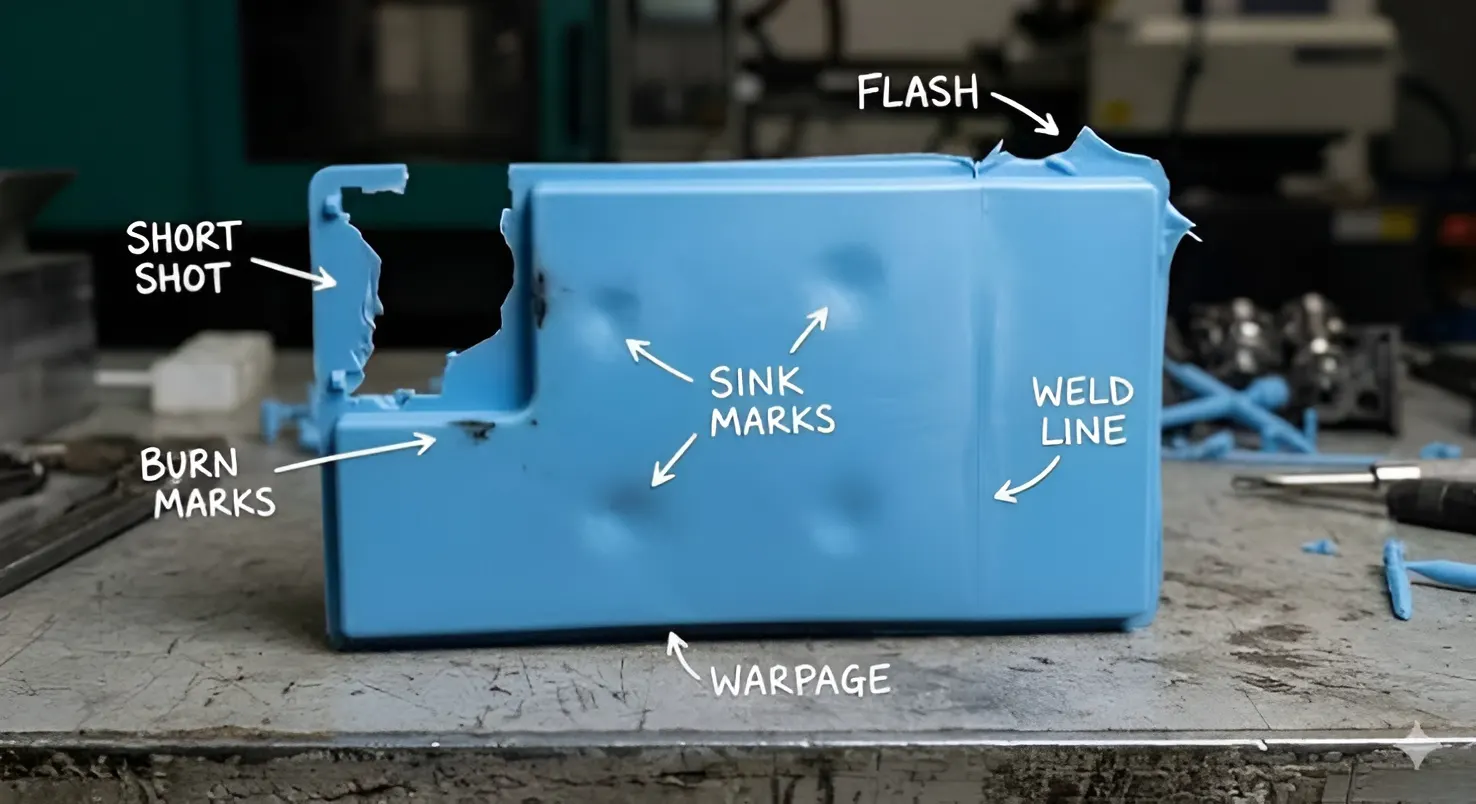
When short shots and flash appear in the same production run, document their relationship before approving a mold modification. A photo of an incomplete corner and another photo of excess material do not show whether they came from the same part, cavity, cycle or production condition.
A short shot leaves the cavity incompletely filled. Flash is excess material that escapes the cavity, including at a parting line or ejector-pin location. Autodesk's troubleshooting references discuss several possible contributors across mold condition, filling, machine capability and processing. Neither symptom, alone or paired, identifies the cause in your project.
That is why the first purchasing decision is whether you have enough evidence to commission a defined investigation. It is usually too early to compare two modification prices when the suppliers are interpreting different samples.
Use this relationship table as a practical recording framework. It is an editorial checklist, not a diagnostic standard or a test for assigning liability.
| What your samples show | What to record | Question still unresolved |
|---|---|---|
| Both defects on one physical part | One sample ID; mark both locations | What explains that particular combination? |
| Different defects in different cavities in one cycle | Cycle ID plus each cavity ID | Is there a cavity-specific difference? |
| Flash and short shots on different cycles | Sequence, timestamps and change records | Did production conditions differ? |
| Unidentified samples collected from a bin | Mark their origin as unknown | Can the samples be traced before comparison? |
Keep good reference parts alongside defective parts where available. A record of only the worst samples hides what the comparison set contained. Do not infer that an absent defect was checked unless someone actually inspected for it.
Build one cavity-by-cycle evidence record
Agree with the reviewer which observations are needed and who will collect them. Record the sampling window and how parts were selected. Leave unavailable information visible; do not backfill settings, cavity numbers or times from memory as if they were measured records.
The following fields are a suggested starting point for the review, rather than a universal acceptance specification:
- Identity: part number and revision, mold identifier, cavity identifier if traceable, machine identifier, material grade and lot.
- Sequence: sample ID, cycle or shot reference, timestamp, and whether the part came from startup, normal running or a restart.
- Symptoms: short-shot location, flash location, whether each was inspected, and a labeled photo reference.
- Context: relevant production and maintenance records, material preparation records where applicable, and timestamped changes made during the sampling window.
- Comparison: acceptable samples from the same window, inspection method, applicable drawing or approved sample, and any known differences between records.
Describe the observed frequency without converting it into a cause. A symptom that recurs in one location and a symptom that appears occasionally both deserve investigation. Intermittent defects can still involve the mold; consistent defects can still involve other contributors.
For example, write "flash observed on 6 of 20 inspected parts from cavity B" rather than "cavity B is a mold problem." State whether the other 14 parts were inspected for the same feature and whether the 20 parts were consecutive or selected.
Illustrative calculation, not a process limit: suppose 20 traceable samples contain 6 with flash, 5 with short shots and 2 with both. That is 6 + 5 − 2 = 9 parts with at least one of these defects. Counting 11 would double-count the two paired samples. These assumed counts do not establish a production defect rate or an acceptable threshold.
For a production-release decision, agree the actual sample selection and acceptance criteria with the responsible quality and engineering teams. The small example only explains how to keep the evidence count consistent.
Use the pattern to frame the investigation, not to select a fix
Autodesk lists multiple possible causes for each symptom and cautions that resolving one molding problem can introduce another. This supports considering the overall evidence before choosing a correction; it does not establish which cause applies to your tool.
Turn each proposed explanation into a review question with an evidence gap. Ask the engineer to distinguish an observation, a hypothesis and a confirmed finding. The table below organizes that discussion without prescribing machine settings or mold-design changes.
| Review area | Evidence to put beside the samples | Decision the review should support |
|---|---|---|
| Mold condition and cavity differences | Identified samples, available condition and maintenance records | Is a targeted mold inspection justified? |
| Machine and production history | Machine identity, cycle records, interruptions and change log | What checks are needed before attributing the issue to tooling? |
| Material identity and handling | Approved grade, actual lot and available preparation records | Are the comparison samples materially comparable? |
| Part requirements and inspection | Current revision, defect locations and agreed evaluation method | Which observed differences affect acceptance? |
More than one area may need review. A proposed mold inspection is different from authorizing a physical modification. Keep the scope of evidence collection, diagnosis and any later corrective work separate so each can be accepted on its own deliverables.
If the dispute began before tooling approval, compare the current evidence with the release questions in our DFM review checklist. That checklist helps organize unresolved requirements; it does not retrospectively prove a production root cause.
Two hypothetical situations that require different briefs
Situation A: different cavities, same cycles. An eight-cavity tool produces incomplete parts in one cavity and flash in another during the same recorded cycles. The buyer initially receives two close-up photos without cavity labels. One supplier quotes a mold modification, while another asks for a production record.
The useful next step is to retain identified samples across the affected and apparently acceptable cavities from a documented window. Attach both defect locations to the same cycle reference where possible. Ask each reviewer what comparison or inspection is missing before they can support their proposed scope.
This evidence might justify a targeted inspection, further production checks or both. It does not by itself prove that the runner, venting, material or machine is responsible. Paying for a defined investigation can be more defensible than approving a modification whose rationale cannot be matched to the samples.
Situation B: different symptoms before and after an interruption. Flash is observed in samples taken early in a run, while short shots appear in samples collected after a restart. The buyer wants the tool builder to guarantee that one modification will remove both symptoms.
First compare the sample chronology with the interruption record and any documented changes. If the original samples cannot be traced, say so and agree how a new comparison set will be collected. Avoid presenting samples from different conditions as proof of one simultaneous event.
The timing relationship helps define the questions, but it does not establish causation or rule out a tooling issue. Agree who will review the restart context, who will inspect the tool if needed, and what finding would justify moving from investigation to corrective work. Both situations are invented planning examples, not MoldShifu customer cases.
Compare investigation and rework quotes on the same scope
Ask each provider to respond to the same evidence package. Request a list of missing inputs before treating a price as a comparable offer. An initial desk review, an on-site investigation and physical tooling work are different deliverables even when the quote uses the same word, "troubleshooting."
Use this scope sheet to record written answers. The prompts do not imply that every provider offers the listed work.
| Quote item | What to confirm in writing |
|---|---|
| Initial review | Records and samples included; questions it will answer; limits of a remote review |
| Further investigation | Proposed checks, responsible party, required access and deliverable |
| Proposed correction | Finding it addresses; authorization required; assumptions and exclusions |
| Verification | Which requirements and both symptoms will be checked; comparison method and agreed production context |
| Handoff | Findings, revised documents where relevant, sample identification and unresolved issues |
Do not accept "flash improved" as the entire verification record if the original complaint included incomplete parts. Ask the team to report both symptoms and any other agreed acceptance features under the agreed verification conditions.
Confirm responsibility for the next decision as well as the next task. Who approves additional investigation? Who can authorize a change? Who accepts the evidence afterward? Record what happens if the investigation does not support the originally proposed correction.
Prepare a focused tooling-review request
For a production rescue review, start with a concise problem statement, identified photos and the records already available. Include the part and mold revisions, material identity, cavity and cycle references where known, inspection requirements, and a summary of changes already attempted with their observed outcomes.
State the decision you need help making: whether to investigate further, whether a proposed mold correction has adequate support, or how to define verification before authorizing work. Mark unknown inputs clearly. Agree a suitable private file-transfer route before supplying proprietary drawings or detailed production records.
For an initial inquiry, a useful statement is: "Short shots and flash have been observed in this run. Here is what we can trace to the same part or cycle, here is what remains unknown, and here is the proposed work we need reviewed." That gives a reviewer a concrete scope without pretending that the root cause has already been established.
Common questions
Can I request an initial review if I have no cycle-level records?
Yes. Identify the records and samples you do have and mark their limits. Ask what an initial review can establish and what additional collection or access would be needed before a modification recommendation.
Should suspect samples be trimmed or otherwise altered before review?
Agree how to preserve representative evidence before altering the samples. If trimming or other handling has already occurred, record it and retain any unaltered examples available so reviewers know what they are comparing.
Does an intermittent defect rule out a mold problem?
No. Frequency describes the observed pattern. It does not identify or exclude a cause. Give the reviewer the traceable samples and context needed to assess the possible contributors.
Can a supplier quote a fixed correction price before finding the cause?
Ask what that price actually covers, which assumptions it depends on, and how additional findings change the scope. Treat an investigation fee and a modification price as separate items unless the written proposal clearly combines them.